
What & Where It Is
- Located in north-west England, primarily within the county of Cumbria (historically parts of Cumberland, Westmorland and Lancashire). Encyclopedia Britannica+2Wikipedia+2
- The area largely aligns with the Lake District National Park, which was established on 9 May 1951. Wikipedia+1
- The park covers about 2,362 km² (912 sq miles). Lake District National Park+1
- Roughly 58 km (36 miles) wide (west-to-east) and 64 km (40 miles) north-to-south. Lake District National Park
Landscape & Geology


- The Lake District is defined by fells (hills/mountains) and lakes, carved out by glaciation over the last ~2 million years. Wikipedia+1
- Highest peak: Scafell Pike at 978 m (3,209 ft). Wikipedia+1
- Deepest lake: Wast Water (in Wasdale Valley) at ~74 m deep. Lake District National Park+1
- The largest lake by area is Windermere (about 14.8 km²) and is also the longest natural lake in England. Great British Bucket List+1
- Geologically, it’s complex: volcanic, sedimentary and granitic rocks underlie the terrain; these contribute to the ruggedness and variety of forms. Wikipedia
Culture & Literary Heritage
- The Lake District has long inspired writers and poets: William Wordsworth lived at Grasmere and Rydal Mount; his poem “I Wandered Lonely as a Cloud” was inspired by daffodils there. cottages.com+1
- Beatrix Potter spent time there and the landscapes influenced her work. cottages.com
- It was designated a UNESCO World Heritage Site (as a “cultural landscape”) in 2017. Wikipedia
- Art, music, and more recently film/tourism have all drawn on the region’s character. Great British Bucket List+1
Nature, Wildlife & Environment
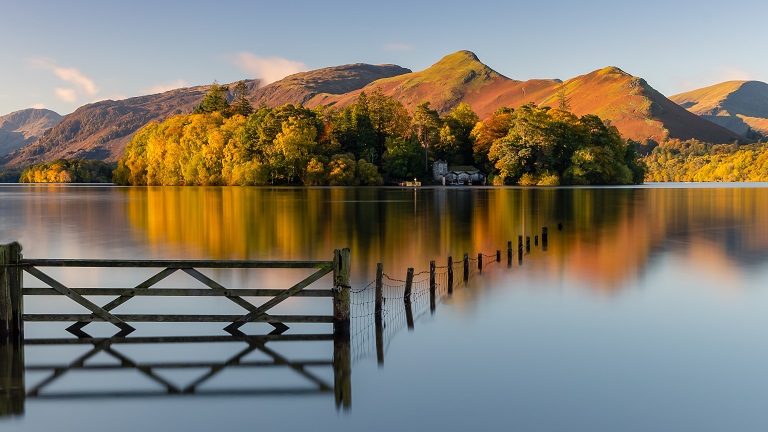


- Climate: It’s one of the wettest parts of England. For example, Seathwaite in Borrowdale records ~3,300 mm of rain per year. Wikipedia+1
- Wildlife highlights:
- Land use: Much of the land is agricultural, especially sheep farming (notably the Herdwick breed). Farming helps shape the traditional landscape (stone walls, pasture, open fell). Great British Bucket List+1
- Conservation issues: With heavy rainfall, steep terrain, and significant tourist traffic, managing erosion, biodiversity and water quality is a continuing challenge.
Tourist Experience & Things To Do
- Walking & hiking – From gentle valley walks to ambitious climbs (Scafell Pike, Helvellyn, etc).
- Water activities – Boating, kayaking, swimming (season/weather-dependent) on lakes such as Windermere, Ullswater, Derwentwater.
- Towns and villages – Charming spots like Ambleside, Keswick, and Windermere itself offer good bases, cafés, shops, accommodation.
- Heritage & culture – Visit Wordsworth’s Dove Cottage, Beatrix Potter’s Hill Top, local stone-built churches, old mining areas.
- Relaxation & scenery – If you just want to escape into nature, stay at a cottage in the hills or a lakeside lodge and soak the beauty in.
- Seasonal variation – Spring: daffodils and lambs; Summer: longer days; Autumn: colour in the woods; Winter: potential snow, crisp landscapes (but weather more unpredictable).
- Hidden gems – Avoid the most crowded spots; explore quieter valleys, lesser-visited lakes, off-peak times.
Practical Travel Tips
- Best months: Late spring through early autumn tend to have more stable weather. But be prepared for rain any time.
- Transportation: If possible, rent a car—many scenic spots are best reached this way. Public transport exists (buses, trains) but may restrict access to remote areas.
- What to pack: Good walking boots, waterproof/windproof layers, map or GPS, layered clothing. For water activities bring swim gear, appropriate shoes.
- Accommodation: Book ahead in busy times; consider staying outside the main hubs for more peace and local character.
- Respect the land: Stay on marked paths, don’t disturb wildlife or vegetation, adhere to local rules—for example many areas are sensitive upland habitats.
- Crowds: Some lakeside towns get busy in peak season; consider staying in a quieter valley or visiting early/later in the day.
- Food/local gastronomy: Try regional dishes and local produce—e.g., Cumberland sausage is a local speciality. Windermere Marina Village
Blog-Friendly Angles & Content Ideas
Since you’re working on travel-blog content, here are some strong angles you might pursue:
- “A day in the life of a Lake District fell walker” – capture the experience of rising early, hiking to a peak, panoramic views, ending in a village pub.
- “Hidden lakes beyond Windermere” – focus on lesser-visited lakes/tarns, why they’re quieter, how to reach them, what makes them unique.
- “Literary trails of the Lake District” – mapping places connected to Wordsworth, Potter, Ruskin; how these landscapes shaped ideas and art.
- “Seasonal changes in Lakeland” – compare spring’s fresh greens and lambs vs. autumn’s fiery foliage vs. winter’s silent snowscape (and how travel differs).
- “Sustainable travel in a celebrated landscape” – how to visit responsibly, what local conservation efforts exist, how tourism impacts the region.
- “From fells to lakes: an itinerary for 3 days” – give a practical travel plan with funds for bloggers: where to stay, where to eat, what to see, how to avoid crowds.
- “Local flavours & lesser-known experiences” – explore village cafés, local farms, craft shops, small guided tours, rural pubs with stories.
https://youtu.be/hzq3p7mijZM?si=vs0p87uQ1V5Bu9fm
Quick Facts You Can Drop In
- The park is England’s largest national park by area (~2,362 km²). Lake District National Park+1
- Highest mountain: Scafell Pike (978 m). Wikipedia+1
- Deepest lake: Wast Water (~74 m deep). Lake District National Park
- The Lake District receives one of the highest rainfall rates in England (some places >3,000 mm/year). Wikipedia+1
- It houses two UNESCO World Heritage Sites (the cultural landscape of the Lake District and also parts of the Frontiers of the Roman Empire). Lake District National Park
#LakeDistrictNationalPark #HikingUK #OutdoorAdventure #NatureLovers #ScenicViews #TravelPhotography #MountainHikes #WildUK #LakesAndFells #Wanderlust #WordsworthCountry #BeatrixPotter #BritishHeritage #CulturalTravel #Anslation #Carrerbook